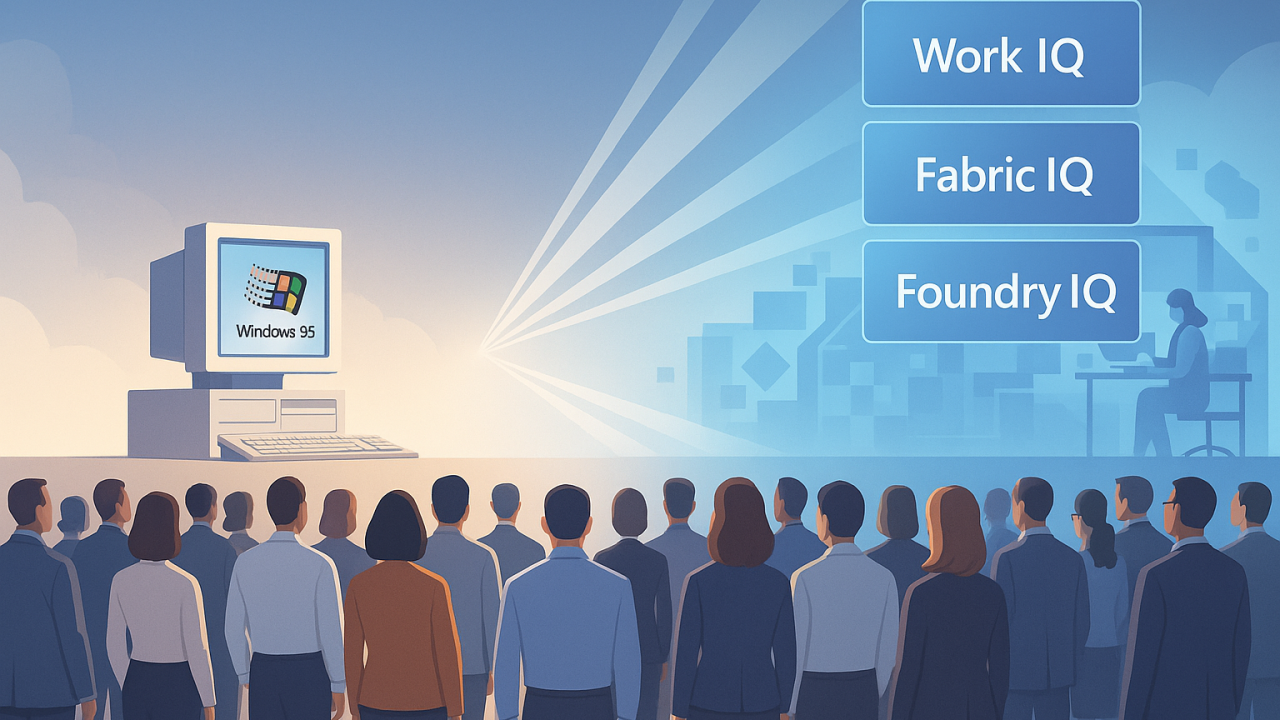
Microsoft has a track record of changing what’s possible when technology becomes accessible to everyone. In the 1980s, Bill Gates famously envisioned “a computer on every desk and in every home,” and Microsoft delivered exactly that. Today, the company is attempting a similar transformation with artificial intelligence — but on a far larger scale.
At Ignite 2025, Microsoft introduced Work IQ, Fabric IQ, Foundry IQ, and support for more than 11,000 AI models. Taken together, these announcements point to a unified strategy: make advanced AI usable, secure, and ubiquitous for every organization, just as Windows once did for personal computing.
It’s democratization all over again — only this time, the platform is intelligence.
A Vision of “AI for Everyone”
Under Satya Nadella, Microsoft has shifted from being a software company to becoming the “intelligence engine” of the AI era. What stands out is the intentionality behind the strategy:
- Deep AI embedded into products people already rely on (Office, Windows, GitHub, Dynamics).
- A broad model ecosystem rather than a one-model ideology.
- Security and governance baked into every layer, not bolted on afterward.
- Natural language interfaces that turn complex AI into something approachable for everyday users.
This model of accessibility and abstraction mirrors how Microsoft approached the PC era: remove friction, eliminate complexity, and empower people to do more — without needing to become technologists.
The “IQ” Stack: Microsoft’s New Context Layer
A highlight of Microsoft Ignite 2025 was the unveiling of Work IQ, Fabric IQ, and Foundry IQ — three synergistic intelligence layers forming what Microsoft calls a “unified context layer” for AI agents. This architecture directly addresses one of AI’s biggest challenges: context. In AI, providing relevant context and data to models is akin to an operating system providing hardware support — it’s essential for reliability.
Work IQ – The User Context Layer: Work IQ is built into Microsoft 365 and captures the human context of work: how people collaborate, communicate, and get things done day-to-day. It observes signals from emails, chats, meetings, documents, and more to understand organizational patterns. This rich personalization means an AI assistant can go beyond generic answers, instead responding with the relevance and tone of a helpful colleague who knows your workflow.
Fabric IQ – The Data Context Layer: Fabric IQ brings together an organization’s analytical and operational data into a unified model. Built on Microsoft Fabric, it essentially provides AI with a real-time digital twin of the business — a consolidated view of enterprise data kept up-to-date from systems like Power BI, Azure Data Lakes, and operational databases.
Foundry IQ – The Knowledge Context Layer: Foundry IQ acts as a unified knowledge retrieval system spanning all enterprise information sources. It connects AI agents to files in SharePoint, wikis, intranet pages, emails, and web data — all under a permission-aware, policy-governed framework. Rather than using a naïve web search, an agent backed by Foundry IQ can perform sophisticated, iterative searches and only surface information the user is allowed to see.
Together, these three layers function as Microsoft’s cognitive fabric for AI — an analog to the Windows OS layer but for enterprise intelligence. No competitor today owns the full ecosystem (productivity software, cloud data platform, and enterprise security) required to build something analogous at scale.
An Open Ecosystem of Models
Another pillar of Microsoft’s democratization strategy is choice. At Ignite, Microsoft revealed that its Azure AI Foundry platform now hosts more than 11,000 AI models — the “broadest model selection on any cloud.” The catalog includes OpenAI’s GPT-4+, Anthropic’s Claude, Cohere’s models, Meta’s LLaMA, and many others.
This parallels Microsoft’s 1990s strategy of making Windows run on virtually any PC hardware. Just as that approach fostered a competitive hardware market, Microsoft’s multi-model approach fosters a healthy AI market where the best model for each job can be employed.
The Foundry Model Router can dynamically select and route a query to the best-fit model based on criteria like cost, speed, and quality — invisible to the end-user. This is exactly the kind of abstracted access that opens AI to far more people.
Security, Trust, and Abstracted Complexity
Democratizing technology isn’t just about access; it’s also about trust and ease-of-use. The new Foundry Control Plane centralizes identity, policy, and security controls for all AI agents and applications, allowing IT departments to govern AI usage just as they govern user access or device management.
Abstracted access means making AI consumption as simple as using any cloud service. A user in Word can ask in natural language for a document summary without worrying about which model is handling the request. A developer can call a single endpoint to get an answer grounded in enterprise data, without manually coding search over SharePoint, vector embeddings, and so on.
By handling these concerns centrally, Microsoft lowers the barrier for organizations to embrace AI without having to build their own security frameworks or worry about compliance blind spots.
Parallels to the PC Revolution
Microsoft’s current trajectory has unmistakable echoes of its early playbook in personal computing. In the 1980s and 1990s, Microsoft didn’t invent the microprocessor or the personal computer — it created the conditions for mass adoption. Fast forward to today, and the same principles apply:
Ecosystem & Scale: Just as Windows became the platform for an ecosystem of hardware manufacturers and software developers, Microsoft’s AI platform is becoming a canvas for the entire AI community.
Abstraction of Complexity: In the early days, one needed significant expertise to operate a computer. Windows abstracted that complexity with GUIs and hardware drivers. Today, raw AI models are like the early command-line — powerful but arcane to most. Microsoft’s Copilots and IQ layers abstract AI behind natural language interfaces.
Affordable Access: By fostering competition and variety, Microsoft is driving toward a world where AI is cost-effective at scale — reminiscent of how the PC ecosystem drove down hardware prices.
Trust and Ubiquity: In the 90s, “nobody ever got fired for buying Microsoft” became a trope. Microsoft is cultivating the same trust in its AI offerings by addressing security, reliability, and ethics head-on.
Conclusion
Microsoft’s current AI strategy — exemplified by Work IQ, Fabric IQ, Foundry IQ, and a rich multi-model Foundry ecosystem — is meticulously designed to democratize AI in the enterprise and beyond. By providing the infrastructure, platforms, and integrations, Microsoft lowers the bar for AI adoption in much the same way it once did for personal computers.
History shows that the companies which make technology easier, cheaper, and safer to use are the ones that drive its widespread adoption. Microsoft is leading with breadth (thousands of models), depth (contextual IQ layers), and trust (enterprise security) — a combination that positions it at the forefront of the next technological revolution.